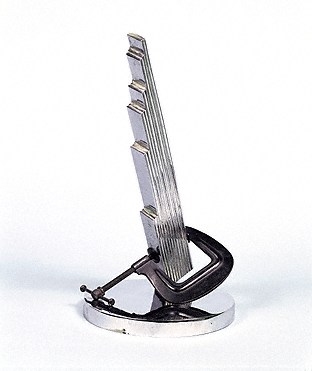
I really enjoy the idea of altermodern. It was only a matter of time before the latest ism was applied to our current attitude toward art. All social and philosophical stand points are based on or are a reaction to the past present and future. There is no reason movements in art would be any different. I found, upon studying each of the three artist, there are often elements of altermodern they posses, however in my mind may not be truly altermodern.
The artist Aaron T Stephan is an artist that posses some of the things that are considered to be altermodern. However I don't feel his work speaks the altermodern language quite as well as some other contemporary artists.
This piece, from a body of work named Building houses/ hiding under rocks speaks to more of a postmodern ideal. He has taken refuses books and built structures out of them. The idea of build a house out of books, seems more like taking and object, changing it's context and presenting it as art. A very postmodern idea.
One could also look at the strictly conceptual side of the piece. Looking at the idea of information or knowledge and how it is obtained or held. Stephan presents a situation where the viewer can actually walk into a room constructed from "knowledge". I feel the altermodernist would like this idea of quasi knowledge. The question of knowledge, where dose it come from and how it is obtained is one of the most important ideas artist have to navigate these days.
The other side of the same coin is the fact that no one is actually gaining any of the information that is written in these books. The piece relies simply on the fact that they are books.
A question I start to ask my self is what is the affect of the time the piece was created and how it is portrayed to the world. Being constructed 2008 of course it was going to be shown on the internet. Not to mention the on line interview by the Quint Gallery. By simple virtue of being posted on line dose that make it altermodern? I don't think so.
I don't believe Aaron T Stephan is an altermodern artist. Some of his ideas can be viewed as altermodern however I believe he is working with more a postmodern mindset.
His personal cite. http://aarontstephan.com/home.html
Quint Gallery. http://quintgallery.com/tag/aaron-t-stephan
This piece by Jeff Koons,Triple Hulk Elvis quantifies so many tings altermodern. The idea of appropriated or misappropriated information is very much a altermodern idea.
The ideas presented in TED Talks revolve around What I feel was Koons artistic process while creating this piece. Taking a pop icon such as the Incredible Hulk and superimposing what appears to be an image of Elvis singing sounds quite postmodern. However I feel there is a certain aesthetic along with a cultural background that makes it less postmodern and more altermadern. The imagery speaks directly to the pop eye candy born in postmodernism but with more current techno twist.
I feel that this work is really designed to be affective viewed on the computer. Not to say it would be out of place gracing the walls of a gallery but it is understood that it was created there and there it will stay. In my mind, this poses another question of "new gallery". To view great art work anybody can sit down in front of their computer and be connected with just about everything the art world has to offer. How important is the gallery or museum to the altermodern? Has it been replaced by the computer?
I think this piece by Koons starts to ask many of these questions. Maybe, in it's own right this piece is answering some of them as well. This idea I struggle with a bit, I suppose I will wait around for the art world to answer them for me.
http://www.friendsofart.net/static/images/art3/jeff-koons-triple-hulk-elvis-iii.jpg
The work by Sara Worden speaks directly to the altermodern ideas of the effect of globalization on agriculture.
Altermodernist looks at this idea of global verses local and nowhere is that more present than the current state of agriculture. Worden's performance/ installation, She waits for rain, to me, asks some of these questions. What is the affect mass agriculture has had on a small town in Mexico? How can this small community fix it's agriculture to put it back to the more sustainable way of life that existed there until the last few decades?
These question are question that the altermodern are interested with. The affect of globalization and what is it doing on a much smaller scale. She waits for rain looks at the importance of water to this community and how it has been effected by large scale farming in the area. It also looks back as it looks ahead. By performing on the grounds of an abandon house Worden plays with the idea of history in response to a current day problem. The way life was and the way it is today.
Worden also built a community garden using plants from the installation. The idea of taking something that maybe view as a problem and turning it into a solution is also an idea I would loosely consider altermodern. Again I would look at the idea of appropriation or re-purposing.
I do feel Sara Worden is altermodern. From her subjects such as global agritulture, I feel she looks back to the way things once where and combine them with the way things are today. She address a problem and then suggests a solution.
http://saraworden.blogspot.com/
print making 1
Thursday, April 21, 2011
Monday, March 7, 2011
Watch out, it's Man Ray
I have decided to use the Man Ray ready made Cadeau for the inspiration for the next work. The piece consists of an old iron with a handful of nails that has been applied to the ironing surface. I have always enjoyed the modernist take on art. Simply changing the context in which an object exists, apply the label "art", presto art. I know that it has a frustrating side to it, one can't help but to find it a bit contrived. Pushing that a aside for a moment, I feel that this was an extremely important time and was instrumental in developing modern art as we practice and view it today.
My real idea with making a print featuring Man Rays Cadeau is the idea taking a ready made and recreating it in a bit more artful and less matter a fact way. I'm taking his context and throwing it out the window, "take that Man Ray". I love the idea of making a pretty picture out of something so raw and rough. Not only do I mean that in a physical scene but also in response to many of the predominant ideas of the modernist area. I feel by creating a print of this image I am taking control of Man Rays intended context and perhaps turn it into a more conceptual attainable piece of art.
Sunday, February 27, 2011
Man Ray
The Fantasies of Mr. Seabrook 1930
Cadeau 1921
New York 1971
As an artist, I feel implicitly that we should have some understanding of the historical context in which we create art. Not to say we need to characterize our selves as art historians, but simply some consciousness of how history frames our art. My personal option is that modernism, in a ciprocal scene, is the artistic high water mark of contemporary art. I feel that artist such a Duchamp and Ray are largely to blame for the movement of postmodernism. Doing a great job of pushing a revolution to the point of quasi cultural acceptance, to then witness the recoil.
After attending studio art school for four years I have a pretty good scene of art history committed to memory, a lot of this is stream of consciousness. I did look at a few articles about Ray but most of this is accumulated knowledge. I feel that Maine College of Art's artistic principles lie largely in postmodernism. It was often tough to grapple with and forced me to spend a lot of time thinking about what post postmodernism was going to look like. A large portion of my time was spent on modernism and the artists of the movement.
I feel that Rays outward gesture to the art world was his benevolence for the movement of modernism. His contributions to the movement can only be compared to artists such as Duchamp and jointly, I feel there passion for Dada and general modernity forced the movement into true acceptance.
The bottom two images I fell are pretty self explanatory, the top image is only to illustrate how far reaching Rays abilities were. Besides I think it is sort of a funny image. He was probably a little before his time on that one, I can only imagine what the critic's said.
Not sure what you want for a bibliography. None of the information I have came directly from the articles I read. If you need me to change something or try to better assign informational credit, I will do my best
http://adrunkenduck.blogspot.com/2010/06/man-ray.html
http://www.britannica.com/EBchecked/topic/492395/Man-Ray
The Fantasies of Mr. Seabrook 1930
Cadeau 1921
New York 1971
As an artist, I feel implicitly that we should have some understanding of the historical context in which we create art. Not to say we need to characterize our selves as art historians, but simply some consciousness of how history frames our art. My personal option is that modernism, in a ciprocal scene, is the artistic high water mark of contemporary art. I feel that artist such a Duchamp and Ray are largely to blame for the movement of postmodernism. Doing a great job of pushing a revolution to the point of quasi cultural acceptance, to then witness the recoil.
After attending studio art school for four years I have a pretty good scene of art history committed to memory, a lot of this is stream of consciousness. I did look at a few articles about Ray but most of this is accumulated knowledge. I feel that Maine College of Art's artistic principles lie largely in postmodernism. It was often tough to grapple with and forced me to spend a lot of time thinking about what post postmodernism was going to look like. A large portion of my time was spent on modernism and the artists of the movement.
I feel that Rays outward gesture to the art world was his benevolence for the movement of modernism. His contributions to the movement can only be compared to artists such as Duchamp and jointly, I feel there passion for Dada and general modernity forced the movement into true acceptance.
The bottom two images I fell are pretty self explanatory, the top image is only to illustrate how far reaching Rays abilities were. Besides I think it is sort of a funny image. He was probably a little before his time on that one, I can only imagine what the critic's said.
Not sure what you want for a bibliography. None of the information I have came directly from the articles I read. If you need me to change something or try to better assign informational credit, I will do my best
http://adrunkenduck.blogspot.com/2010/06/man-ray.html
http://www.britannica.com/EBchecked/topic/492395/Man-Ray
Monday, February 21, 2011
Cannonball Press
This exhibit was a lot of fun. It is very clear that there is an overall scene of humor to the work. The large scale crazy carny prints are totally ridiculous. I think that the artists are perfectly happy with the viewer being confounded, confused or hopefully humored. I really enjoyed the super pulpy, freak show nature of the carny prints. They conger up thoughts of a time long scene past where big top tents loured people from far and wide to come gander at the bearded lady and three legged chickens. People love the freak show, weather discussed or not they cant help but to look. The same mentality that forces you to slow down while driving by a car accident in hopes of seeing a body or a decapitated arm that has been flung down the road a ways.
The print that states "man or monkey, you decide" speaks a language of social commentary. The idea of capitalist wasteland forces me to look at this monkey as some type of diplomat or political figure. Reinforcing the idea that the person at the top is little more than a well developed mammal who's interests included eating bananas and flinging poo. Not necessarily the most important attributes for a person that is in control of a large number of people.
I loved their artist statement. Having read plenty of them, and having written a few my self, at times they can have a feel of ego masturbation. Saying to your self "I know you think you're great and all, but what dose this have to do with your art". Their statement is more like a recipe for crazy as hell. For some I realize it will be a bit challenging, hopefully an good and engaging challenge. For others, I am certain they will see the inherent humor and fun in the thing.
I also wanted to point out that by having prints priced at $20, it not a huge investment for most people. I really love the idea of affordable art, helping to change the stigma of a art only for the wealthy. It is sad for me to think that many people have the idea that art is not to be grasped by the common man. The overly intellectual patron walking into a gallery and slapping down a wad of cash for something that looks as if it could of been painted by a four year old. This work dose a good job with mass appeal, not to say everyone will like it, more that the subject matter is pretty straight forward.
This is a great body of work. Not overly confusing and a lot of fun. I think many people will really be engaged. Some of the work is a bit one liner, but I think that is what make some of it really rich.
The print that states "man or monkey, you decide" speaks a language of social commentary. The idea of capitalist wasteland forces me to look at this monkey as some type of diplomat or political figure. Reinforcing the idea that the person at the top is little more than a well developed mammal who's interests included eating bananas and flinging poo. Not necessarily the most important attributes for a person that is in control of a large number of people.
I loved their artist statement. Having read plenty of them, and having written a few my self, at times they can have a feel of ego masturbation. Saying to your self "I know you think you're great and all, but what dose this have to do with your art". Their statement is more like a recipe for crazy as hell. For some I realize it will be a bit challenging, hopefully an good and engaging challenge. For others, I am certain they will see the inherent humor and fun in the thing.
I also wanted to point out that by having prints priced at $20, it not a huge investment for most people. I really love the idea of affordable art, helping to change the stigma of a art only for the wealthy. It is sad for me to think that many people have the idea that art is not to be grasped by the common man. The overly intellectual patron walking into a gallery and slapping down a wad of cash for something that looks as if it could of been painted by a four year old. This work dose a good job with mass appeal, not to say everyone will like it, more that the subject matter is pretty straight forward.
This is a great body of work. Not overly confusing and a lot of fun. I think many people will really be engaged. Some of the work is a bit one liner, but I think that is what make some of it really rich.
Sunday, February 13, 2011
Question 5. A few terms I looked up
Brethren of the Common Life: An association founded in the 14th century that was focused increasing Christian deviation. Started by G Groote, he embraced a simpler life largely guided by the love of god.
Lay Piety: As I understand, lay in this context relates to the lay people or the common people. Piety is the devotion to god or a reverence for god. The common persons devotion to god.
Brethren of the Common Life: An association founded in the 14th century that was focused increasing Christian deviation. Started by G Groote, he embraced a simpler life largely guided by the love of god.
Lay Piety: As I understand, lay in this context relates to the lay people or the common people. Piety is the devotion to god or a reverence for god. The common persons devotion to god.
Question 3.
There are a lot of parallels between the printing press and the photocopier. They can be used to do the same thing, replicate images or text. There is also the is also the idea of being able to recreate or replicate a piece of art. This would be one of the greatest benefits to both processes. The ease of replication allows the object to be more attainable by a greater number of people.
This idea of replicating art brings up an interesting question of authenticity. Is there an original, or is the edition of prints seen as a whole. How is this different from photocopies and how are they viewed. Are a bunch of photocopies that are identical seen an edition. I feel that the print, be it singular or part of an edition, can be seen as it's own individual piece or art. Where the photocopier art needs a certain amount of deviation from it's raw form. Many of the photocopied pieces we looked at were multimedia or colauge where the photocopy is a component. I would have a hard time with photocopy in the raw being presented as a finished piece of art. I suppose that brings up the ever present questions of what is and is not art. We will leave that one alone for now.
Question 4.
There are a lot of parallels between the printing press and the photocopier. They can be used to do the same thing, replicate images or text. There is also the is also the idea of being able to recreate or replicate a piece of art. This would be one of the greatest benefits to both processes. The ease of replication allows the object to be more attainable by a greater number of people.
This idea of replicating art brings up an interesting question of authenticity. Is there an original, or is the edition of prints seen as a whole. How is this different from photocopies and how are they viewed. Are a bunch of photocopies that are identical seen an edition. I feel that the print, be it singular or part of an edition, can be seen as it's own individual piece or art. Where the photocopier art needs a certain amount of deviation from it's raw form. Many of the photocopied pieces we looked at were multimedia or colauge where the photocopy is a component. I would have a hard time with photocopy in the raw being presented as a finished piece of art. I suppose that brings up the ever present questions of what is and is not art. We will leave that one alone for now.
Question 4.
![]() | ||
| Michael McCurdy ilustration for Man Who Planted Trees |
Subscribe to:
Comments (Atom)